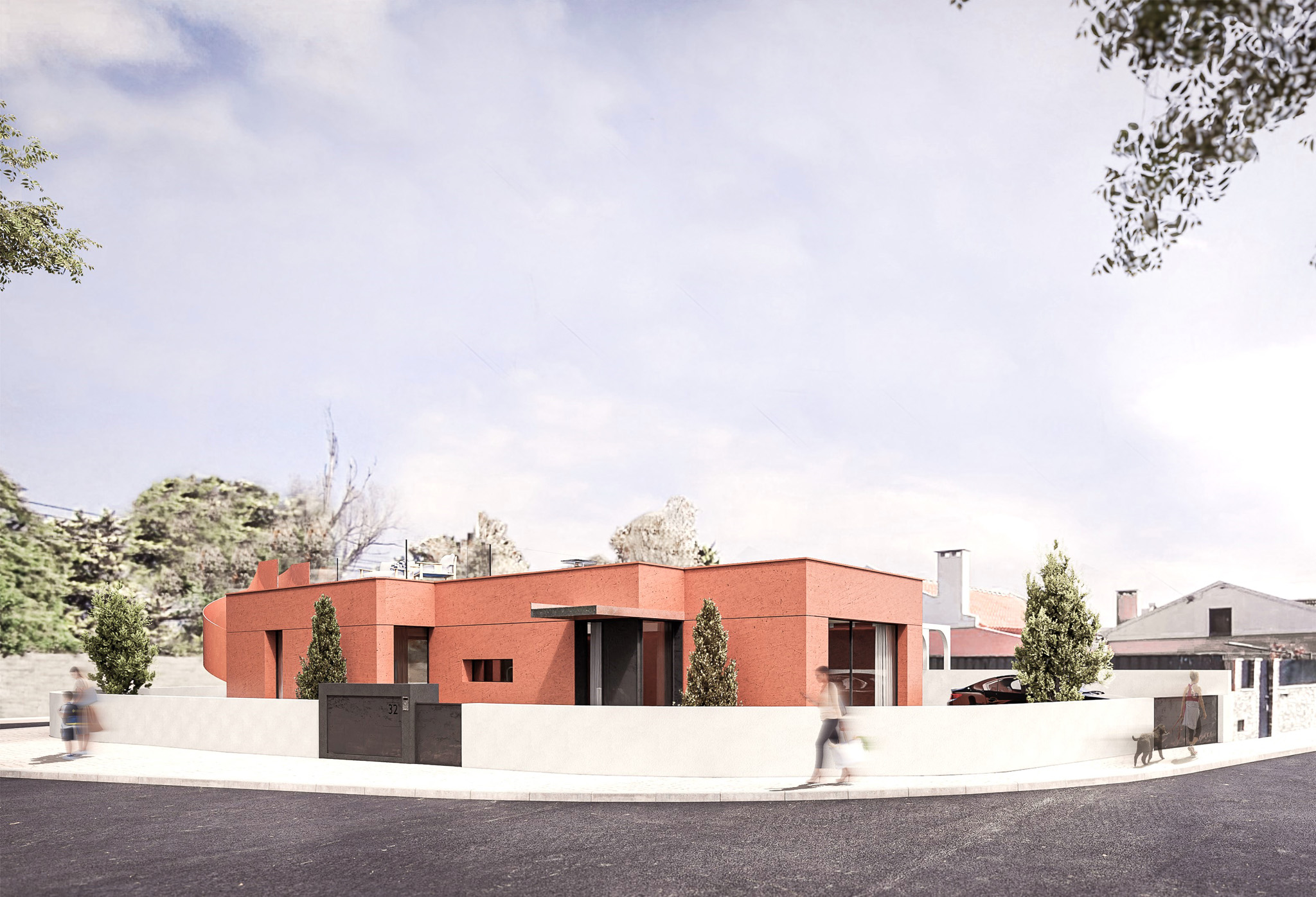
The House in Sintra was born from the interpretation of a small, corner plot, where the constraints of the Municipal Master Plan became the driving force behind the project. The impossibility of building on two floors led to the exploration of a compact and dynamic single-story volume that extends across the site through recesses and broken planes.
The architectural gesture translates into a composition of solids and voids that define an enveloping and fragmented façade, capable of generating depth, movement, and variation of light. Chromaticism assumes a central role here: the warm tone, close to the color of brick, establishes a bridge with local tradition and with the surrounding ceramic roofs, reinterpreting them in a contemporary language of pure lines and continuous surfaces.
The spatial organization is articulated around a central axis of living, where the social spaces open onto the small courtyard, extended by the accessible rooftop terrace. The result is a dwelling of restrained scale and expressive character, which reconciles formal modernity and constructive memory.